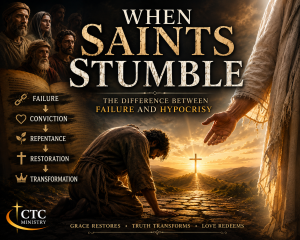
When Saints Stumble…The Difference Between Failure and Hypocrisy
Podcast: Play in new window | Download
Welcome.
Today I’d like us to step away from our journey through the early church for just a little while.
Over the past several weeks we’ve spent time with Barnabas…
Peter…
James…
Mary Magdalene…
Ignatius…
Justin Martyr…
Polycarp…
Tertullian…
As I prepared those episodes, something kept returning to my mind.
None of these people were perfect.
In fact, if we’re honest…
Some of the greatest men and women in Scripture failed in remarkable ways.
Which raises a question.
If God uses imperfect people…
What makes the difference between a saint… and a hypocrite?
Let’s walk together for a few minutes and see what Scripture has to say.
The Bible Never Hides Human Failure
One of the reasons I’ve always trusted the Bible as a historical document is because it doesn’t read like propaganda.
Most ancient civilizations polished the reputations of their heroes.
The Bible doesn’t.
It tells us about Noah becoming drunk.
It tells us about Abraham lying.
It tells us about Moses losing his temper.
It tells us about David committing adultery and arranging the death of Uriah.
It tells us about Peter the Apostle denying the Lord he loved.
Those stories aren’t there to embarrass God’s people.
They’re there because they’re true.
And because God isn’t writing the story of perfect people.
He’s writing the story of redeemed people.
The Pattern
As I looked at these stories, I noticed something.
The pattern repeats again and again.
Failure.
Conviction.
Repentance.
Restoration.
Transformation.
That is the rhythm we see throughout Scripture.
Not because God’s people never sinned…
But because when they were confronted with the truth…
They had a choice.
Some confessed.
Some hardened their hearts.
The Bible records both.
David and Saul
Perhaps the clearest example is found in two kings.
King Saul.
And David.
Both sinned.
Both were confronted.
But their responses were very different.
Saul explained.
Saul blamed circumstances.
Saul defended himself.
David simply said,
“I have sinned against the Lord.”
David’s confession didn’t erase the consequences.
His family still suffered.
His kingdom still bore scars.
Forgiveness is not the same as the removal of consequences.
But confession reopened the door to fellowship with God.
Peter and Judas
The New Testament gives us another comparison.
Peter.
And Judas Iscariot.
Both betrayed Jesus.
Peter denied Him.
Judas handed Him over.
Neither man was without guilt.
Yet one returned.
One allowed himself to be restored.
The other never came back to the One who was willing to forgive him.
The difference wasn’t simply what they had done.
It was what they did afterward.
So What Is Hypocrisy?
Today we often use the word “hypocrite” to describe anyone who sins.
But I don’t think that’s how Scripture uses the word.
A hypocrite isn’t someone who falls.
A hypocrite is someone who insists there has been no fall.
Someone who presents an image of righteousness…
While refusing to acknowledge the truth.
There’s an enormous difference.
Christians stumble.
Every one of us does.
The question is not whether we have failed.
The question is whether we are still willing to repent.
The Danger of Self-Justification
One of the first things that happened after sin entered the world was blame.
Adam blamed Eve.
Eve blamed the serpent.
Throughout history we see the same temptation.
To explain.
To justify.
To minimize.
To compare ourselves with someone else.
Repentance moves in the opposite direction.
It says,
“I was wrong.”
There is something deeply freeing about those words.
Because once we stop defending ourselves…
God can begin transforming us.
Walking With This Today
Perhaps that’s why I find the lives of the saints so encouraging.
Not because they never failed.
But because many of them allowed God to change them.
Barnabas became an encourager.
Peter became a shepherd.
Mary Magdalene became a faithful witness.
Polycarp endured.
None of them began as finished people.
They became people who kept saying “yes” to God’s work in their lives.
Maybe that’s what sanctification really looks like.
Not pretending we’re already complete.
But allowing Christ to continue shaping us.
A Question for Ourselves
It’s easy to recognize failure in someone else’s life.
It’s much harder to recognize it in our own.
Perhaps today the Holy Spirit isn’t asking us to examine someone else’s heart.
Perhaps He’s quietly asking us to examine ours.
Where have I become defensive?
Where have I stopped listening?
Where have I mistaken stubbornness for faithfulness?
Where might God be inviting me—not to shame—but to repentance?
In Closing
The older I become, the less impressed I am by people who claim they’ve never been wrong.
And the more impressed I become by people who can quietly say,
“I was wrong.”
“I’m sorry.”
“Please forgive me.”
Those may be some of the most Christlike words we ever speak.
Because the Gospel has never been about pretending we don’t need grace.
It’s about discovering that God’s grace is greater than our failures.
So if you’ve stumbled…
You’re in good company.
The pages of Scripture are filled with men and women who stumbled.
What made them saints wasn’t that they never fell.
It was that, by God’s grace, they kept getting back up.
And perhaps that’s the invitation Christ extends to each of us today.
Not to defend ourselves.
Not to pretend.
But simply…
To come home.
I’m Hank Wilson, I’ll see you next time on “Living a True Christian Life”