Eight Woes: When Religion Forgets God
Podcast: Play in new window | Download
Scripture: Matthew 23:1–39
There is a question I’ve asked on more than one occasion, and it’s a question I believe every Christian ought to consider.
What if Jesus walked into one of our churches today?
Not as a painting hanging on the wall. Not as a figure in a stained-glass window. Not as someone whose words we can conveniently interpret to support whatever position we already hold.
But Jesus himself.
What if he walked into an Evangelical church on Sunday morning? Or a Progressive Christian congregation? Or one of those churches that prides itself on being somewhere in the middle?
Would he congratulate any one of them for finally getting Christianity exactly right?
Or would he find something to challenge in all three?
I suspect that if we listen carefully to the twenty-third chapter of Matthew’s Gospel, we may find an answer.
And it may not be an answer we’re particularly comfortable hearing.
The World Jesus Confronted
To understand Matthew 23, we need to remember something about the world in which Jesus lived.
First-century Judaism was not a single, uniform religious institution. There were different schools of thought, different interpretations of the Law, and different understandings of how the people of Israel should live faithfully before God.
The Pharisees were one important movement within that world. They emphasized the interpretation and observance of the Torah in everyday life. The Sadducees were associated particularly with the priestly establishment and the Temple. Other Jewish groups and teachers offered still different approaches.
These weren’t simply arguments between good people and bad people. They were often serious disagreements among people who cared deeply about their religious heritage.
Jesus himself was a Jew, teaching among Jews, using their Scriptures, and participating in debates about what faithfulness to God truly required.
And when he challenged the scribes and Pharisees, he was not condemning an entire people or religion. He was confronting particular attitudes and practices among religious authorities.
That distinction is important, because Christians have sometimes used passages like Matthew 23 to condemn Judaism while overlooking the very same behaviors within Christianity.
In fact, if we read this chapter merely as a criticism of people who lived two thousand years ago, we’ve probably missed its most important lesson.
Because the human tendency to confuse religious authority with righteousness didn’t disappear with the first century.
It followed us right into the modern Church.
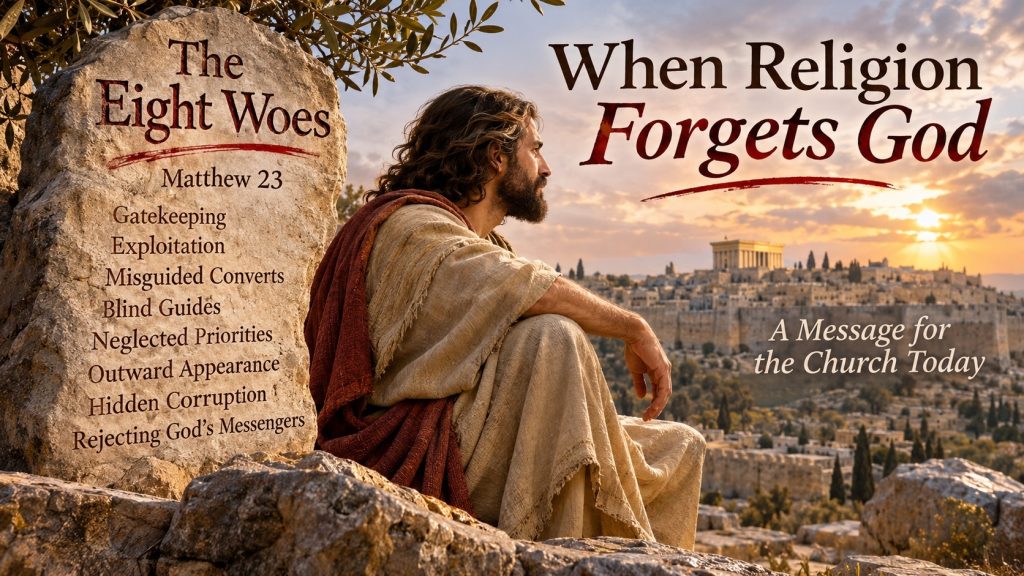
The Eight Woes
In Matthew 23, Jesus delivers a series of warnings traditionally known as the eight woes.
Some modern Bibles count seven, because verse 14 is absent from the earliest surviving manuscripts of Matthew and is generally regarded as a later addition drawn from a parallel Gospel tradition. But the traditional eight-woe arrangement gives us a useful framework for considering the warnings.
And these warnings are remarkable for their directness.
Jesus repeatedly addresses religious hypocrisy. He challenges leaders who impose burdens on others, manipulate religious rules, pursue recognition, and neglect the moral obligations that should stand at the center of their faith.
But before we examine these warnings, there’s something we should understand.
Jesus wasn’t criticizing people for taking religion seriously.
He was criticizing them for taking certain aspects of religion so seriously that they neglected what mattered most.
And that distinction brings us to our first woe.
When We Close the Door
In Matthew 23:13, Jesus condemns religious leaders who shut the Kingdom of Heaven in people’s faces.
Imagine that.
People who believe themselves to be guardians of God’s Kingdom become obstacles preventing others from entering.
How might that happen today?
Perhaps when we become so concerned with deciding who is worthy of belonging that we forget our responsibility to welcome, teach, and serve.
Perhaps when we make acceptance into a religious community depend upon political loyalty, cultural conformity, or agreement with every position held by its leadership.
Now, this doesn’t mean that religious convictions are meaningless, or that a church cannot have standards.
It means we ought to be careful about confusing our standards with God’s authority.
There is a difference between inviting someone to follow Jesus and demanding that they first become just like us.
And that difference matters.
When Religion Becomes an Instrument of Power
The traditional second woe, preserved in some manuscripts as verse 14, condemns religious figures who exploit vulnerable widows while making impressive public displays of prayer.
The underlying warning is unmistakable.
Religion can become a means of taking advantage of the very people it ought to protect.
History provides plenty of examples.
Religious institutions have accumulated wealth and political influence. Some have used that influence to establish schools, hospitals, charitable organizations, and programs that have improved countless lives.
Others have used religious authority to enrich themselves, silence criticism, or protect their positions.
And sometimes, tragically, both things have happened within the same institution.
The question isn’t whether a church has money, a building, or an organization.
The question is what those resources are being used to accomplish.
Are they serving people?
Or are people being used to serve the institution?
When We Make Converts to Ourselves
In verse 15, Jesus criticizes religious leaders who travel great distances to win a convert, only to reproduce their own destructive attitudes.
This is a particularly uncomfortable warning for modern Christianity.
Because we Christians have developed a remarkable number of ways to identify ourselves.
We are Evangelicals, Progressives, Conservatives, Liberals, Traditionalists, and Moderates.
We are Baptists, Methodists, Catholics, Presbyterians, Pentecostals, Episcopalians, and members of countless other communities.
Those traditions have histories, theological convictions, and contributions worth understanding.
But here’s the question.
When we bring someone into our religious community, are we teaching that person to follow Jesus?
Or are we primarily teaching them to defend our denomination, our politics, our interpretation, and our institutional identity?
There’s nothing inherently wrong with belonging to a tradition.
The problem begins when loyalty to the tradition becomes more important than the teachings it claims to preserve.
When We Become Blind Guides
In verses 16 through 22, Jesus challenges religious leaders who have developed elaborate distinctions about which oaths are binding and which are not.
To modern ears, the discussion may seem obscure.
But the underlying issue is quite familiar.
People had become so involved in interpreting the technicalities of religious obligations that they were losing sight of their moral purpose.
We see similar patterns whenever Christians spend more energy debating the precise boundaries of a rule than considering the honesty, fairness, and responsibility that ought to guide their behavior.
Religious reasoning can become extraordinarily sophisticated.
But sophistication isn’t the same thing as wisdom.
And being able to defend a position doesn’t necessarily make that position right.
The Weightier Matters
Now we come to what I believe is the heart of this entire chapter.
Matthew 23:23.
Jesus criticizes religious leaders who carefully tithe even the smallest herbs while neglecting what he calls the weightier matters of the Law.
Justice.
Mercy.
Faithfulness.
Notice what Jesus does not say.
He doesn’t tell them to abandon religious discipline.
He doesn’t tell them that the Law has no meaning.
He tells them that they have misplaced their priorities.
They have become meticulous about smaller obligations while neglecting greater ones.
And I wonder how often we do exactly the same thing.
We can become extraordinarily concerned about the language someone uses, the clothing they wear, the church they attend, or the political positions they hold.
We can debate the correct form of worship, the proper interpretation of a passage, or the appropriate boundaries of Christian fellowship.
Meanwhile, someone is hungry.
Someone is lonely.
Someone is being treated unjustly.
Someone needs compassion.
And we’re still arguing.
Jesus doesn’t suggest that truth and mercy are enemies.
He tells us that justice, mercy, and faithfulness belong at the center of a life devoted to God.
That’s a challenge to every Christian community, regardless of its theology or politics.
The Clean Outside and the Hidden Inside
The next two woes, found in verses 25 through 28, use two powerful images.
First, Jesus describes people who carefully clean the outside of a cup while leaving the inside filled with greed and self-indulgence.
Then he speaks of whitewashed tombs.
Beautiful on the outside.
But concealing death and decay within.
The imagery is harsh, but the meaning is clear.
Religious appearance can conceal moral corruption.
And we should be careful not to imagine that this problem belongs exclusively to one denomination or political movement.
A conservative religious leader can speak passionately about traditional morality while failing to practice honesty or compassion.
A progressive religious leader can speak eloquently about justice while treating those who disagree with contempt.
A moderate religious leader can speak endlessly about unity while refusing to confront wrongdoing.
The labels change.
The danger remains.
We can become so concerned with appearing righteous that we stop examining whether we are actually living righteously.
And perhaps the most dangerous form of hypocrisy is the kind we no longer recognize in ourselves.
Perhaps that’s the most troubling lesson of Matthew 23. We don’t always abandon our principles when we become hypocrites. Sometimes we become so devoted to one principle that we use it to excuse our failure to practice another.
We defend truth without kindness. We pursue justice without mercy. We seek peace without courage.
And because we believe our cause is righteous, we may never notice the contradiction.
The question isn’t simply whether our beliefs are correct. It’s whether the way we live those beliefs reflects the teachings of Jesus.
When We Honor the Prophets but Reject Their Message
The final woe, in verses 29 through 36, concerns religious leaders who honor the tombs of the prophets while sharing the attitudes of those who persecuted them.
There’s a painful irony here.
It’s often easier to honor a prophet after that prophet is safely in the past.
We can celebrate the courage of people who challenged injustice generations ago.
We can build monuments, name buildings, and dedicate holidays to their memory.
But what happens when someone challenges our own assumptions today?
What happens when someone questions the conduct of our leaders?
What happens when someone asks whether our religious practices are actually consistent with the teachings we claim to follow?
Do we listen?
Or do we immediately begin defending ourselves?
History reminds us that religious communities have sometimes resisted voices of reform, only to celebrate those same voices generations later.
And perhaps that should make us a little more humble about our own certainty.
Because it’s entirely possible to admire the courage of yesterday’s reformers while rejecting the uncomfortable questions being asked today.
What If Jesus Walked Into Our Churches?
And now we return to the question with which we began.
What if Jesus stood before the different Christian communities of our time?
Would he congratulate one of them for finally getting everything right?
Consider the Evangelical Christian who believes deeply in the authority of Scripture, the importance of personal faith, and the responsibility to live a moral life.
There is much in that commitment worthy of respect.
But what might Jesus say if biblical authority were used to justify cruelty, exclusion, or the pursuit of political power?
Would he remind such a believer that justice and mercy are also biblical obligations?
Now consider the Progressive Christian who emphasizes inclusion, compassion, social justice, and concern for those who have been marginalized.
There is much in that commitment worthy of respect as well.
But what might Jesus say if concern for justice became contempt for anyone who disagreed, or if political activism began to replace spiritual humility?
Would he remind such a believer that loving our neighbors includes those whose opinions we find difficult?
And what about those of us who prefer to stand somewhere in the middle?
We value reasonableness. We dislike unnecessary conflict. We want people to get along.
Those can be admirable qualities.
But what might Jesus say when our desire to avoid conflict becomes an excuse for doing nothing?
When we recognize injustice but remain silent because speaking would make someone uncomfortable?
Would he remind us that peace and justice are not always achieved by remaining neutral?
You see, none of these groups is immune from the warnings of Matthew 23.
And none has a monopoly on the virtues Jesus taught.
This doesn’t mean every disagreement is equally important, or that every position is equally defensible.
Jesus himself made moral judgments.
He challenged wrongdoing.
He spoke with conviction.
But his authority wasn’t derived from belonging to the correct political faction.
And his concern for righteousness was inseparable from his concern for people.
Perhaps that’s something all of us need to remember.
The Danger of Being Certain
There’s another lesson here that I believe deserves our attention.
Religious certainty can be comforting.
It gives us a sense of belonging. It helps us understand the world. It provides answers to difficult questions.
And conviction, in itself, is not a bad thing.
But certainty becomes dangerous when it convinces us that we no longer need to listen.
When we assume that disagreement must come from ignorance, dishonesty, or evil intentions.
When we begin measuring other people’s faithfulness by how closely their opinions resemble our own.
At that point, our religious identity may become a barrier to the very humility that faith ought to cultivate.
And that brings us to something remarkable about the conclusion of Matthew 23.
The Lament Over Jerusalem
After delivering these severe warnings, Jesus turns his attention toward Jerusalem.
In verse 37, he laments over a city that has rejected those sent to it.
And he uses an extraordinary image.
He describes how often he longed to gather Jerusalem’s children together, as a hen gathers her chicks beneath her wings.
Think about that image for a moment.
Not a conquering general.
Not a triumphant political leader.
Not a religious official celebrating victory over his opponents.
A mother hen gathering her chicks.
Protection.
Tenderness.
Concern.
After all the warnings, all the condemnation of hypocrisy, all the challenges to religious authority, Jesus expresses sorrow.
And I think that tells us something important about the spirit in which these warnings ought to be understood.
They are not an invitation for us to congratulate ourselves because we have identified the hypocrites in somebody else’s church.
They are an invitation to examine our own lives.
To ask whether our convictions are producing compassion.
Whether our religious practices are producing justice.
Whether our faith is producing humility.
And whether the people who encounter us are more likely to experience the love of God or merely the weight of our opinions.
A Question for Each of Us
So perhaps we should stop asking which group of Christians Jesus would agree with today.
Perhaps the better question is whether we are willing to agree with Jesus when his teachings challenge our own group.
When he tells us to love our enemies.
When he tells us to care for the vulnerable.
When he challenges hypocrisy.
When he warns against the pursuit of recognition and power.
When he places justice, mercy, and faithfulness above religious performance.
Are we listening?
Or are we busy explaining why those words apply primarily to somebody else?
Because the danger of Matthew 23 is not simply that religious leaders can become hypocrites.
It’s that any of us can.
And the moment we become convinced that we are incapable of such hypocrisy may be the moment we most need to hear these warnings.
“When our commitment to being right becomes more important than our commitment to doing right, religion has lost its way.”
Closing
Nearly two thousand years have passed since the words recorded in Matthew 23 were first spoken.
Empires have risen and fallen.
Religious institutions have grown, divided, reformed, and sometimes divided again.
Christianity has spread across continents and developed traditions that would have been unimaginable to the people who first heard Jesus teach.
But human nature has changed remarkably little.
We still struggle with pride.
We still seek recognition.
We still defend our own communities while finding fault with others.
We still sometimes confuse being right with being righteous.
And we still find it easier to recognize hypocrisy in someone else than to acknowledge it in ourselves.
So I leave you with the question we began with.
If Jesus walked into our churches today, would he find people so concerned with defending Christianity that they had forgotten to practice it?
Or would he find people striving, however imperfectly, to live according to his teachings?
People who value truth without abandoning compassion.
People who pursue justice without surrendering humility.
People who practice faithfulness without turning faith into a weapon against their neighbors.
People who tell others that it’s ok to come as you are? No fancy clothes. No need to pretend you’re somebody you’re not. Just people gathering together in faith.
Perhaps the greatest challenge of Matthew 23 is not deciding which modern Christian group most resembles the Pharisees Jesus criticized.
Perhaps it is recognizing that the warnings were never meant to give us another group of people to condemn.
They were meant to call us toward something better.
Toward justice.
Toward mercy.
Toward faithfulness.
And toward the kind of love that Jesus demonstrated even when confronting those with whom he most profoundly disagreed.
The eight woes were spoken long ago.
But the question remains.
Are we willing to hear them today?
Thank you for listening, and may God bless you.