Stop Mis-Using Prayer……the truth about the act of and power of prayer
Podcast: Play in new window | Download
It’s time that American “Christians” stop mis-Using Prayer…the truth about the act of and power of prayer
There are several types of prayer. There is the negotiation prayer – it is like hey God, if you do this for me, I promise to do this later. When I was young this used to be one of my favorites I needed something from God. It was ‘dear Lord, if you let me catch a fish, I promise that I’ll be a good boy when I’m home’ or ‘dear God, if you help me pass this test, I promise I’ll study harder next time’.
Today I want to talk about prayer, types of prayer, the act of prayer, and the power of prayer and also about how many modern “Christians” need to stop mis-Using Prayer…the truth about the act of and power of prayer.
There is the desperation prayer. I’ve used this one also, it is based on things are going really bad and I am in so far over my head that I cannot possible get out, I am desperate for your help. Of course, after I get out of my jam, I’ll forget I ever brought it up, but for now, I really mean it.
There is the thankful prayer, this is probably one of the most honest prayers, it is when you are truly thankful for something that you have received. There is the I am so sorry prayer, you’ve messed up and are asking for forgiveness. There is the I want stuff prayer, which is based in the belief that God will give us whatever we want.
There are preachers who proclaim the ‘name it and claim it theology’ or the ‘prosperity gospel’ teach that God exists to make us happy on this earth. They teach that as long as you truly believe in your heart then when you ask God for something He will give it to you; especially if you have planted a seed of money in their ministry. That you will become happy and fulfilled and life will be skittles and bits. The question then is does God solely exist to insure that we have a happy carefree life here on earth and to become happy and wealthy all we have to do is pray every day for material success and wealth.
I agree that we should pray and pray every day. I once heard a minister say prayer should be a lifestyle and he was right. Prayer needs to become as central to our daily lives as breathing; after all, we would not be breathing if not for the grace of God. Therefore, it makes sense to talk to him daily and to thank him daily for our lives. It is always ok to ask him to intercede for us when we need help, we just need to make sure we do not always expect him to miraculously fix everything for us (although miracles can and do happen), but if they happened every time, they would not be miracles.
We must be careful about not only what we pray for, but also how we pray.
Is there any real answer about prayer in the teachings of Jesus? The answer to that question is of course and today I will look at the act of prayer, types of prayer, what we should expect from our prayers and what does it mean when God says no to our prayers.
How should we talk to God? How should we approach God in prayer? Jesus offers some specific instructions on the subject of types of prayer.
In the Gospel of Matthew in chapter 6, the apostles ask Jesus to teach them how to pray. His answer is in verses 9-13:
“Pray, then, in this way: ‘Our Father, who is in heaven, Hallowed be your name.
‘Your kingdom come, your will be done, on earth as it is in heaven.
‘Give us this day our daily bread.
‘And forgive us our debts, as we also have forgiven our debtors.
‘And do not lead us into temptation, but deliver us from evil.
[For Yours is the kingdom and the power and the glory forever. Amen.’]”
A prayer that is simple, clean and to the point. Starting with a greeting to God and an acknowledgment of who he is and how special he is. After that, we place his desires above our own and a plea for his kingdom to come to earth so that we will obey him (your will be done) just as those already in heaven do.
Then we request that at this time he help us with our day-to-day obligations and needs.
We then ask him to forgive us our sins (our debts), and that we have to forgive those who have sinned against us. If we have not forgiven, how can we ask God for forgiveness? We really cannot.
Temptation, God will NEVER lead you into temptation, and so this is to emphasize that he is our protector from evil. Keep Satan away from us and help us to reject Satan.
The last line ‘For Yours is the kingdom and the power and the glory forever. Amen.’ Is not in the earliest manuscripts, but it has become an accepted part of the Lord’s Prayer, especially in Protestant denominations. It too is an acknowledgement of the ultimate power of God.
Such a simple, to the point prayer, but how should we pray? I have watched as some stand on street corners loudly proclaiming their prayers, other times I have sat in restaurants while someone prayed for what seemed like 5-10 minutes giving thanks for their meal. Sometimes I think they are praying more so others will notice them than they are genuinely giving thanks to God.
Does Jesus offer any ideas or suggestions on the proper way to approach the father in prayer?
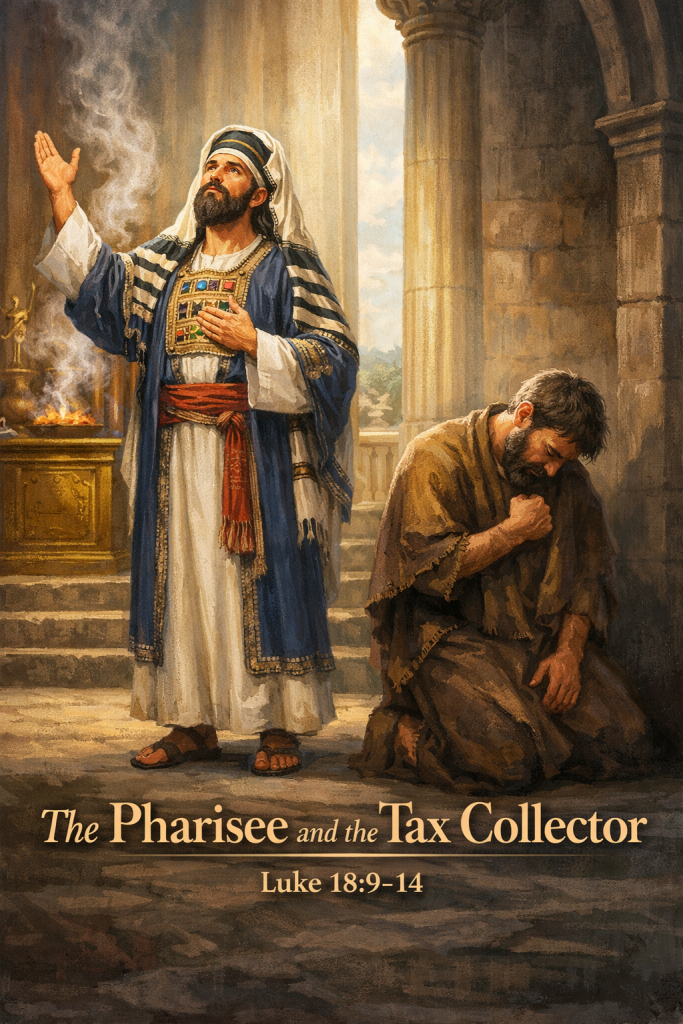
In fact, and I touched on this in the message about prideful prayer vs humble prayer, and I think it is a lesson that bears repeating; in Luke 18 verses 9-14 Jesus talks about approaching the Father in prayer.
“9 And He also told this parable to some people who trusted in themselves that they were righteous, and viewed others with contempt:
Often when Jesus told a parable, he had a specific target audience in mind. Jesus never seemed to take the side of the rich and powerful, in fact, he always took the side of the poor, the sinner, the neglected; those who society considered to be less then themselves. In this case Jesus is obviously speaking to the Pharisees and Scribes, the ‘religious’ ones.
Verse 10: “Two men went up into the temple to pray, one a Pharisee and the other a tax collector.” Our stage is set, as I mentioned above, Jesus is talking about two complete opposites. One a big shot, the other a poor person, in fact one who is considered lower than lower; to some a traitor.
Verse 11: “The Pharisee stood and was praying this to himself: ‘God, I thank You that I am not like other people: swindlers, unjust, adulterers, or even like this tax collector.”
Notice how the Pharisee starts his prayer, he starts not with thanks for his family, his health, not even for the life, that God has given him; instead, he gives thanks that (in his mind) he is better than everyone else is. While elevating the tax collector above some others, he still has a sneer in his prayer. He even begins to brag about how good he is; in verse 12 he says; I fast twice a week; I pay tithes of all that I get.’ He is trying to remind God that he is a good person, because after all, he goes through the motions as a follower of the Law of Moses. The Pharisee is what we term today ‘a legalistic believer’, that is, he believes in the letter of the law, but not the spirit and the deeper meaning.
In verse 13, Jesus then talks about the other man; “But the tax collector, standing some distance away, was even unwilling to lift up his eyes to heaven, but was beating his breast, saying, ‘God, be merciful to me, the sinner!’” This person stands naked before God afraid that he was not worthy to even approach. As he starts to pray, his prayer is a cry of repentance and is strong and honest. Jesus then in verse 14 says; I tell you, this man went to his house justified rather than the other; for everyone who exalts himself will be humbled, but he who humbles himself will be exalted.” Here Jesus is telling us directly that the person who knows he is a sinner but still approaches God humbly and asks for forgiveness is the one upon whom God smiles most favorably. It is not the loud bombastic person who thinks only of himself who receives favor from God.
Exactly what does it mean that God will smile most favorably upon a person? To the prosperity gospel teacher, it means wealth and material success. These ministers often quote one line out of James Chapter 4, and that line is: “You do not have because you do not ask” they state, see you did not have success because you failed to tell God exactly what you desired.
They conveniently ignore the first part of the verse which says “You lust and do not have; so you commit murder. You are envious and cannot obtain; so you fight and quarrel.” They ignore the statements about the person living a life of sin. The reality of that section of scripture is that if you are living a life of sin, asking God for favors usually just does not work. Prayer is not a life preserver; it is a way of life.
So when you put together the entire verse 2 you have; “You lust and do not have; so you commit murder. You are envious and cannot obtain; so you fight and quarrel. “You do not have because you do not ask” James is clearly saying that since the things you want belong to others, and you are in violation of the commandments. Therefore, since you are not in the right frame of mind and since you are not right with God, your prayers fail.
James reinforces this idea inVerse 3 “You ask and do not receive, because you ask with wrong motives, so that you may spend it on your pleasures.” The last line of this verse is, to me, incredibly powerful; ‘so that you may spend it on your pleasures’ James is clearly speaking about those who are praying for monetary blessings.
OK, I get that, if we are living in sin we are not most likely not going to be rewarded by God when we pray for stuff. However, what about those who simply pray for a relationship to work, or a better job? What about when God does not grant those prayer requests? After all asking God for a better life is not wrong, is it?
Absolutely it is ok to ask God to help you find and live a better life. Matthew chapter 21 recounts Jesus telling the parable of the fig tree. Jesus made a fig tree wither and the apostles were amazed and asked Jesus how he did it. In verse 21 And Jesus answers and says to them, “Truly I say to you, if you have faith and do not doubt, you will not only do what was done to the fig tree, but even if you say to this mountain, ‘Be taken up and cast into the sea,’ it will happen. 22 And all things you ask in prayer, believing, you will receive.”
The first part of verse 21, gives the first obstacle that we have to overcome, ‘you must have faith and do not doubt’ the problem is, as a human there always seems to be that little nugget of doubt that manages to creep into our thoughts. Even the Apostle Thomas doubted. Doubt is something that actually can be of benefit to us, because it can make us stop and think before we act. Jesus says that anything we ask for we will receive and he uses the example of moving the mountain.
I have always looked at the ‘mountain’ here to signify an obstacle rather than a physical collection of earth. In my own life, I have found that when I pray for wisdom on how to deal with a situation or a problem and I truly believe that Jesus will help, the answer always shows itself. There have been times when I have doubted I was asking the right question or asking for the correct solution and in those cases, the answer was delayed; it seemed as if God was saying ‘no’ to me.
So what happens when God says ‘no’? Should we get angry, pout, throw a temper tantrum or should we try to figure out what the solution is and ask why did he say no?
When I do not get the answer I want – notice I said that I want, not what God wants; I have to remind myself of a song by Garth Brooks several years ago that has the lines:
‘Sometimes I thank God for unanswered prayers
Remember when you’re talkin’ to the man upstairs
That just because he doesn’t answer doesn’t mean he don’t care
Some of God’s greatest gifts are unanswered prayers’
His greatest gifts are unanswered prayers. Wait a minute I think I know what is best for me. In reality, most times I do not really know what is best for me and when God says no or wait a minute it is because God is protecting us from ourselves, there is something better waiting for us. Think of God’s “No” not as a rejection, but a redirection towards something more fitting for our lives and something that will bring glory to God. It is not a punishment for us, it is preparation for tomorrow, and it will open a door to an adventure with God.
When you pray, make sure your heart, mind, and soul are in the right place. Make sure you pray not for what others have, but what God wants you to have, what will help you live your life for his glory and not your own.
When you pray that humble prayer, that honest prayer, be prepared to listen for his answer, it may not come with a shout, it may come only as a whisper on the wind, but it will come and do not be discouraged if the answer is ‘not yet’. Remember he has a plan for each of us.
I am the Reverend Hank Wilson and thank you for joining me today Thank you for listening – God bless and let’s make prayer a part of our lifestyle and not a life raft